For two years a question has followed me through every project I have touched. What if control in the modern world rarely looks like control? What if the systems that shape what we believe work best when they never announce themselves, when they simply teach us what to fear, what to repeat, whom to trust, and whom to attack? What if nobody has to force obedience anymore, because fear, repetition, authority, belonging, and the drumbeat of emergency do the work quietly on our behalf?
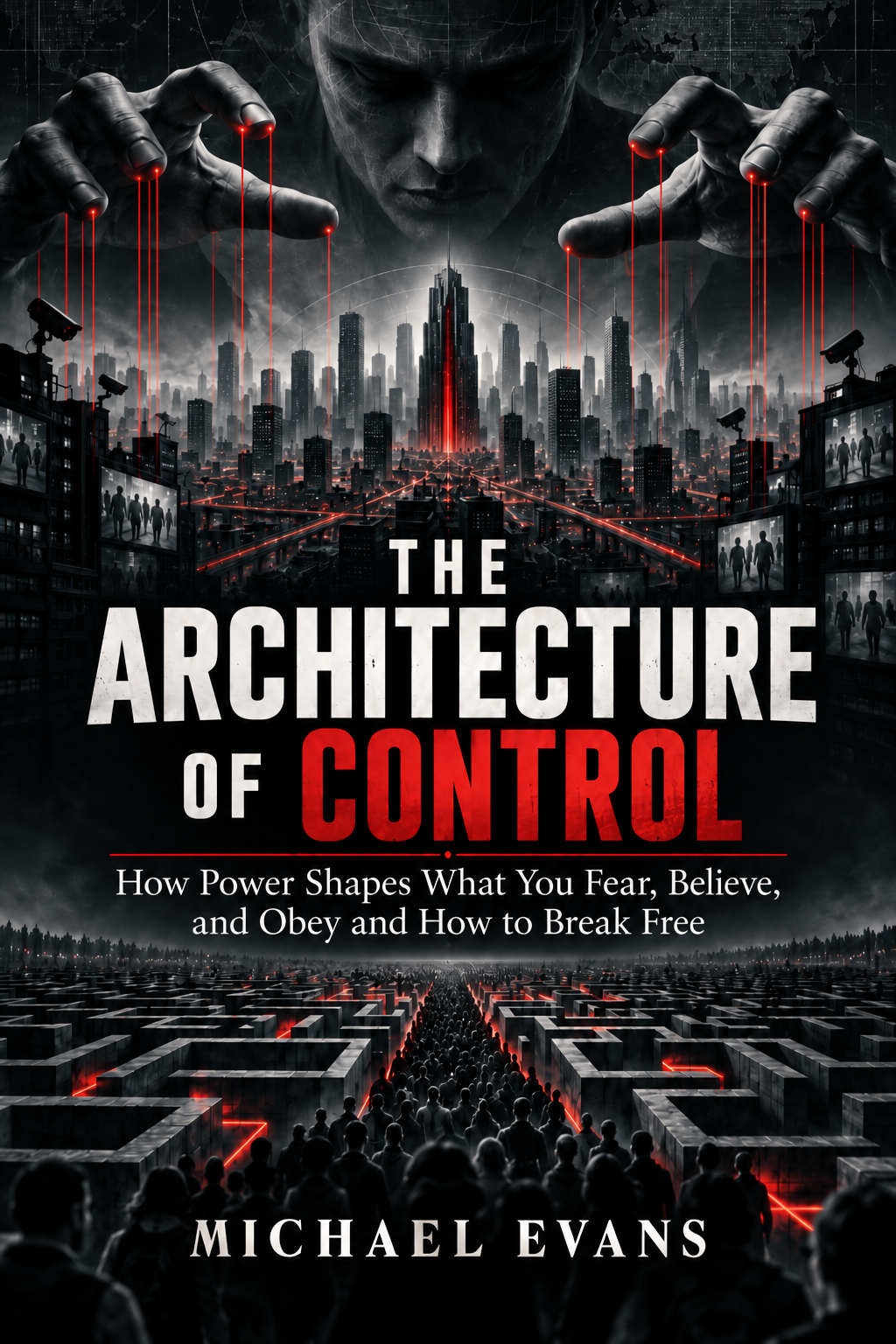
Today I am announcing my answer. The Architecture of Control is the most ambitious investigation I have ever taken on, and it arrives in two parts. The documentary, a long-form film now in production, follows the visible architecture: the institutions, financial structures, emergency powers, and digital systems that have quietly reorganized how the world is governed. The book, The Architecture of Control: How Power Shapes What You Fear, Believe, and Obey and How to Break Free, goes somewhere a camera cannot. It goes inside the mind of the governed.
Before anything else, one clarification. Neither project asks you to accept my conclusions. What they do is take systems normally discussed in isolation, international policy and asset management, emergency authority and digital identity, migration and war, money and psychology, and place them side by side so the pattern becomes visible. Look at that pattern and draw your own conclusion. That act of looking is the entire point.
Both the book and the documentary are in development and coming soon. Here is what they examine.
Control that rarely announces itself
The most effective systems of influence in history share one signature. They rarely compel. They teach. In 1928 the public relations pioneer Edward Bernays wrote about an invisible government that molds minds, forms tastes, and suggests ideas, and he described the manipulation of the masses as a natural, even necessary, feature of democratic life. He was celebrating in print something he believed was already underway. A century later the tools have changed almost beyond recognition. The instinct has stayed exactly where it was.
Consider how your own opinions actually arrive. Very few were reached through quiet study of the evidence. Most arrived through repetition, until a phrase felt true simply because it had been said enough times. Some arrived through authority, adopted because an official or a celebrity said so and no practical way existed to check. Others arrived through belonging, because a belief was the price of admission to a community you could not afford to lose. And many arrived through fear, which has a documented habit of shutting down the exact reasoning we would need in order to evaluate it.
None of this requires a villain in a dark room. Fear, repetition, authority, tribal identity, social pressure, and financial incentive are ordinary features of human society. What changes the situation is scale. When the same handful of narratives is amplified through every screen at once, and when a small set of institutions controls the boundaries of what may be said, the ordinary machinery of human influence becomes an architecture. It can be studied. It has load bearing walls. Once you see the blueprint, you cannot unsee it.
How much of what we believe is actually ours?
The documentary: the visible architecture
The documentary began as an investigation into a possibility that serious people dismiss at their own risk: that governments, international organizations, corporations, financial institutions, technology platforms, and private foundations have been converging, whether by design or by gravity, toward increasingly centralized forms of governance and control. Rather than treat each subject as a separate story, the film follows them as one connected structure.
Along the way it examines the documents and the institutions themselves. Agenda 21 and Agenda 2030, and what the United Nations Sustainable Development Goals look like when a global plan touches every layer of human life. The World Economic Forum and the philosophy of the public private partnership, where the line between public interest and private ambition dissolves. The concentration of institutional ownership at BlackRock, Vanguard, and State Street, and the way ESG frameworks translate that ownership into influence over corporate behavior on every continent. The power of private philanthropy in global health, with Bill Gates as its most visible figure, and what it means for a single foundation to carry weight in global health policy that few nations can match.
It examines the pandemic years with an investigator's patience. Emergency authority and how far it reached. Lockdowns, the closure of enormous numbers of small businesses, and the Economic Injury Disaster Loans that left long-term debt standing behind the aid. Vaccine mandates and the arrival of digital health credentials. It follows the money to the southern border, through the scale of known gotaways during the Biden era, the cartels that industrialized the exploitation of enforcement weaknesses, and the dramatic collapse in crossings once enforcement policy changed, a natural experiment in how quickly the flow reverses when the incentives do.
From there it widens. The Ukraine war and the energy and fertilizer disruption that rippled into food prices across the developing world. Financial sanctions and their side effect, the quiet migration of nations toward payment systems beyond Western control. The concept policymakers themselves call the polycrisis, the idea that many emergencies arriving at once justify coordinating responses at a scale no voter ever approved. Central bank digital currencies and programmable money, and the difference between money as a technology of freedom and money as a technology of permission. The Canadian trucker protest and the freezing of bank accounts, a preview of financial exclusion used against citizens rather than criminals. And behind all of it, a political insurgency against parts of the global institutional model, with Donald Trump as its most visible expression, and the open question of whether decentralizing policies survive the next administration. The film does not pretend to know how that resolves. It asks the question most coverage skips: what happens when identity, finance, travel, employment, communication, and access to services all sit on interconnected systems, and a small number of people control the connections?
A crisis does not have to be created in order to be used
This principle sits at the center of the documentary, and it is the reason the film stays serious instead of sliding into the swamp where this material usually ends up. The project does not claim that every crisis was secretly manufactured. It claims something more defensible, and in my view more disturbing. A crisis does not have to be created in order to be used.
History demonstrates it repeatedly. The financial panic of 2008 became the justification for bailouts that socialized losses while privatizing gains. The attack of 2001 became the justification for surveillance powers that were built in years and never fully walked back. The virus of 2020 became the justification for emergency authority, censorship regimes, and digital credentials that arrived in months after decades of resistance. Emergencies compress timelines. Policies, technologies, and powers that would face years of debate in ordinary conditions get adopted in a week, and very few are repealed when the emergency ends. Whatever you believe about the origins of any given crisis, the pattern of use is documented, and it favors whoever is positioned to benefit.
Once fear makes the decision, evidence usually arrives too late.
The book goes further: the mind is the target
The documentary could have ended with institutions, timelines, and documents. But the deeper I went, the more obvious it became that the film answers half of a question. It shows the architecture. It does not explain why the architecture stands. Buildings of this kind need a foundation, and the foundation of every large-scale control system is individual psychology.
The book therefore moves inward. It examines psychological operations, behavioral influence, and engineered consent as documented practices with a history and a literature. It walks through fear conditioning, authority and obedience, social proof, tribalism, framing, emotional scripts, manufactured urgency, identity, group belonging, and the mechanics of rapid compliance shifts, those strange moments when an entire population seems to change its mind in unison and then forgets it ever believed anything else. It studies information saturation, the point at which a person receives so much conflicting input that surrendering to a prepackaged conclusion starts to feel like relief. And it examines economic pressure and the fear of isolation, the two levers that do most of the quiet work.
At the core of this research sits a framework used in behavioral analysis, known by the acronym FATE. Focus asks what everyone is suddenly being told to look at, and why this issue at this exact moment. Authority asks whether you accept a claim because of the evidence or because of who is repeating it. Tribe asks whether disagreement has been converted into a question of belonging, so that questioning the narrative counts as betrayal of your group. Emotion asks which feeling got activated, fear, outrage, disgust, panic, urgency, and whether it arrived before you had time to evaluate the evidence.
Around that framework the book adds the rest of the toolkit. Checking whether apparently independent sources actually originate from the same place. Noticing micro-agreements, the small yeses that make the big yes feel inevitable. Watching how an issue is framed, because whoever controls the frame usually controls the conclusion. Following financial incentives to see who is paid to hold which opinion. Examining the boundaries of the context you were given. Studying the timing of major events. Learning the classic logical fallacies well enough to catch them mid-sentence. None of it is complicated. All of it is uncomfortable, because the first place these tools turn out to work is on the person holding the book.
The most powerful form of control may be the one you mistake for your own opinion.
The system works when we police each other
Here is the idea the whole project turns on, stated plainly. Technology alone cannot control a population. Government alone cannot control a population. Money alone cannot control a population. The system becomes powerful at the moment people begin policing themselves and one another.
When that happens, people repeat approved ideas because repetition feels like consensus. They stay quiet because exclusion is expensive. They attack outsiders because the tribe rewards it. They seek validation from authority because certainty is comfortable. They respond emotionally before examining evidence, because the emotion arrived first and the evidence takes effort. And they trade autonomy for security, belonging, convenience, or certainty, one small surrender at a time, none of which feels like a surrender while it is happening. This is the seam where institutional control and psychological control meet, and the book is built to examine it.
A society fighting itself
There is a second layer to all of this, and it may be the hardest chapter to write. Modern societies are consumed by horizontal conflict. People fight one another over race, gender, sexuality, abortion, religion, immigration, and political identity. These are real concerns, and the pain on every side of them is real. The book takes none of them lightly.
What it examines is the direction of our attention. While citizens spend nearly all of their energy fighting one another, structural power keeps accumulating vertically: ownership, banking, debt, surveillance, digital identity, centralized infrastructure, and the systems that control access to everyday life. Those subjects rarely trend. They are technical, slow, and difficult, and no algorithm pushes them into your feed at the velocity of last week's fight. The book asks a question I would like you to sit with. What if keeping society permanently divided is itself one of the most effective forms of social control? A population at war with itself does not audit its banks.
The documentary trailer
The trailer for The Architecture of Control is being cut now, and it will premiere right here on this page. If you want to see it the week it drops, the announcement list below is the place to be.
The Documentary
The trailer premieres here
Production is underway. Join the announcement list below and you will see it first.
Escaping the architecture
A project like this could curdle into paranoia. I refuse to let it. The final movement of the book is about freedom, and it is practical. Slowing the emotional reaction long enough to ask where it came from. Recognizing when fear is being used to bypass reasoning. Asking who benefits from a belief before adopting it. Separating evidence from authority, and weighing the first even when the second is loud. Examining opposing evidence honestly, which is a skill that can be practiced. Recognizing tribal pressure in the moment it applies, questioning artificial urgency, spotting repetition designed to feel like agreement, and learning the logical fallacies by name.
It also means something quieter. Becoming comfortable holding an opinion that may be unpopular. Learning to say I am still thinking about that. Discovering that you can decline to choose a side without losing your humanity. Distinguishing genuine consensus from manufactured consent, and realizing that intellectual sovereignty, the state of owning your own perceptions, is a discipline like any other. A person who understands how emotional and social influence actually works becomes substantially harder to manipulate, and a society of such people is the only durable defense against the architecture the documentary documents.
Intellectual freedom begins when belonging stops determining what you are allowed to question.
Why I am the one asking this
Michael Evans brings an unusual background to this subject. He has more than three decades of experience spanning law enforcement, government security contracting, private security, and kidnap and missing-person recovery. He founded USPA Nationwide Security in 2005 and served as its CEO before moving into a strategic advisory role. For more than two decades his work has included locating and recovering missing and abducted girls through pro bono rescue efforts associated with the Kingsman Missing Persons Unit and Kingsman Philanthropic Corp, across the United States and internationally, particularly throughout Asia.
That work amounts to a long education in how decisions get made under pressure. In crisis environments he has watched fear rewrite a person's judgment in seconds. In investigations he has seen how deception is engineered and how authority is manufactured, and how people can be moved to act against their own interests while feeling entirely rational about it. He is also the author of The Real Matrix series, which examines perception, conditioning, identity, and the psychological structures that shape human behavior, and in 2026 he was named a finalist for Author of the Year at the International Impact Book Awards. The Architecture of Control brings those decades of observation into one investigation.
Be the first to know
Both the book and the documentary are in development now. No dates have been set, and I would rather announce them once than promote them twice. When the trailer premieres, when excerpts are published, and when the book is released, the announcement list hears it first. Join below, and keep asking the question underneath all of it: how much of what we believe is actually ours?